Founded in 1910 the Socie’te pour les Apparreils Deperdussin and bought by Louis Bleriot in 1914 and renamed Socie’te pour Aviation et ses De’rive’s. In 1915 ‘Spad’ designer Louis Bechereau began to design a series of fighter aircraft that would use the Hispano-Suiza engine. And its progressively higher horse-powered models. The Spad VII was first flown in combat in August 1916. It became the main French high altitude fighter, using powerplants of 140 - 180hp. Examples were also flown by the Belgian, Brazil, British, Czech, Finnish, Greece, Italian, Peruvian, Polish, Portugese, Rumanian, Russian, Siamese and Yugoslavian Air Services variously from 1918-1928.
Kit History,
Of the seriously ignored kits this ranks high on the list. For years the only game in town was the 1/40 Smer Spad VII. The full shutter radiator arrangement in the Blue Max kit is engraved with the shutters 90 degrees from where they should be. The resin kit by JGMT while finely engraved is very expensive and the wings are very thin and very brittle. Then came the 1/48 Hobby Special issues. Now we have a 1/32 kit that has few flaws and as a build it goes together nicely with a little care. Predrill all rigging pilot holes and scribe through the separation lines for the control surfaces and reset at desired angle.
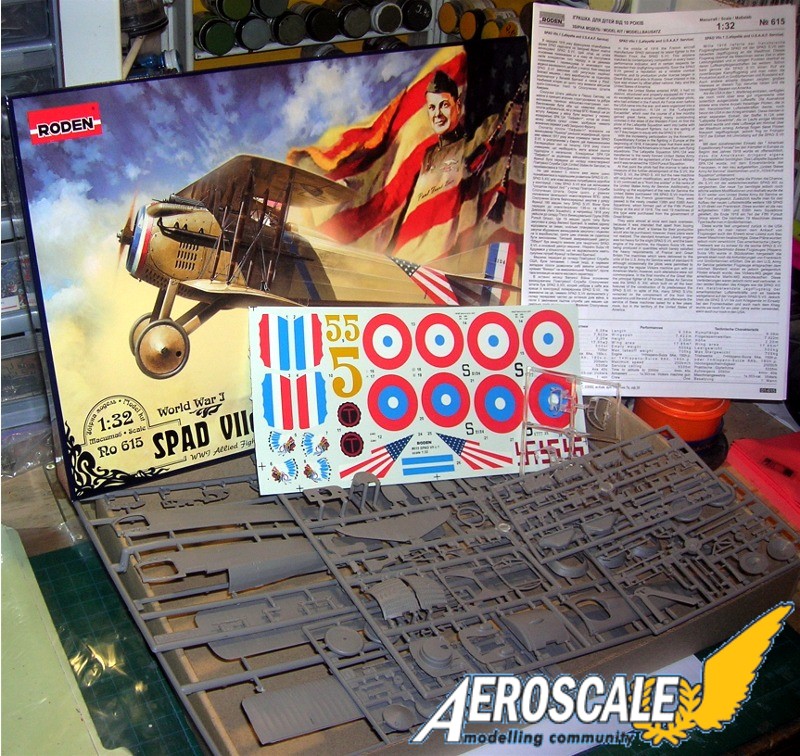
Box Contents,
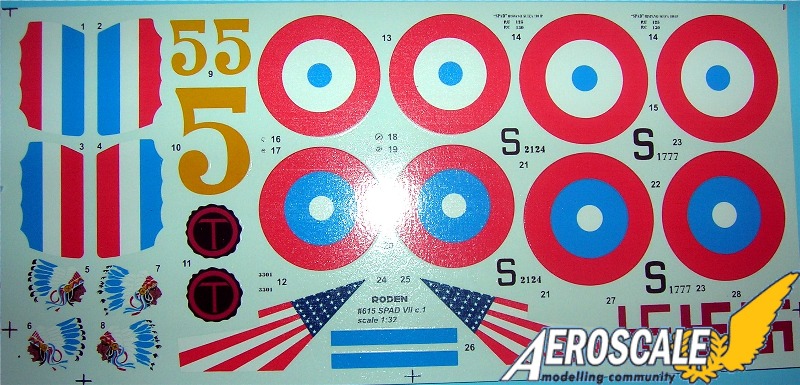
3 profiles
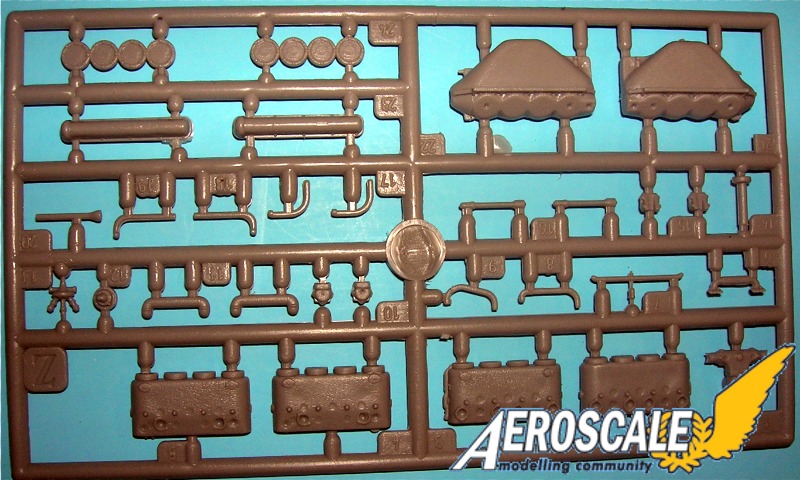
Full Hispano Suiza 150hp (potentially 180hp) motor.
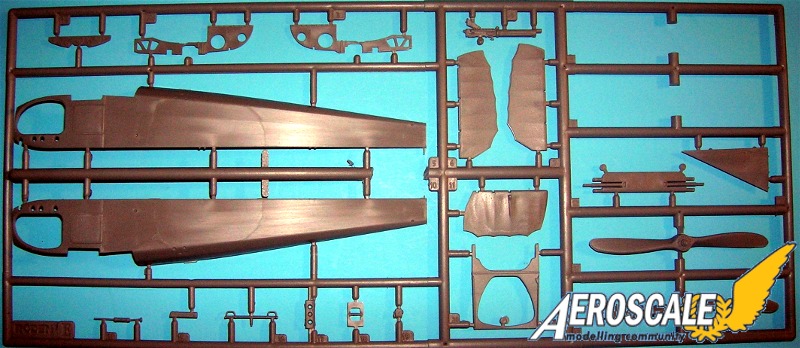
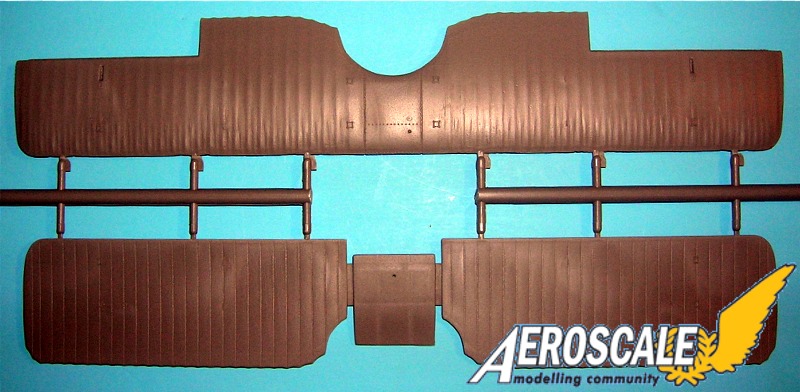
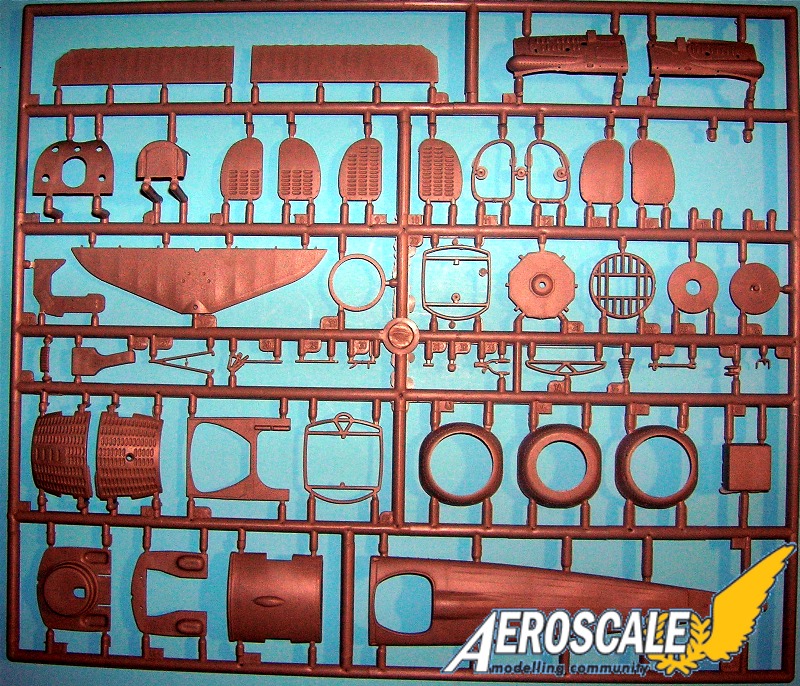
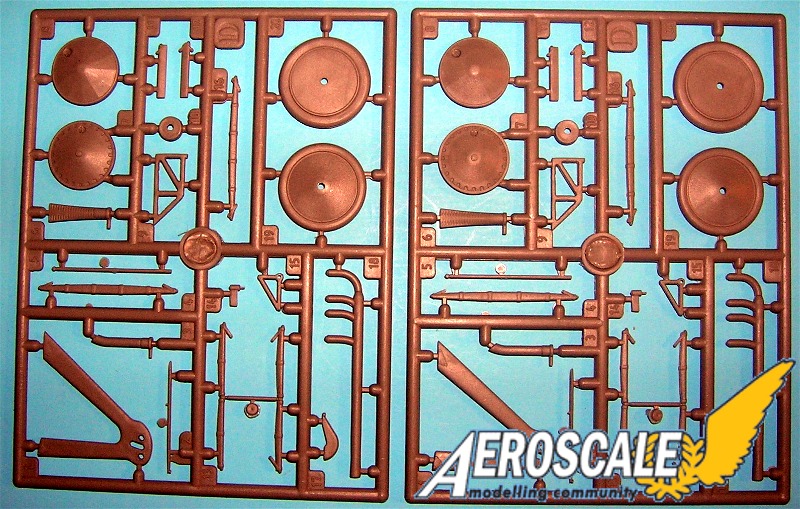
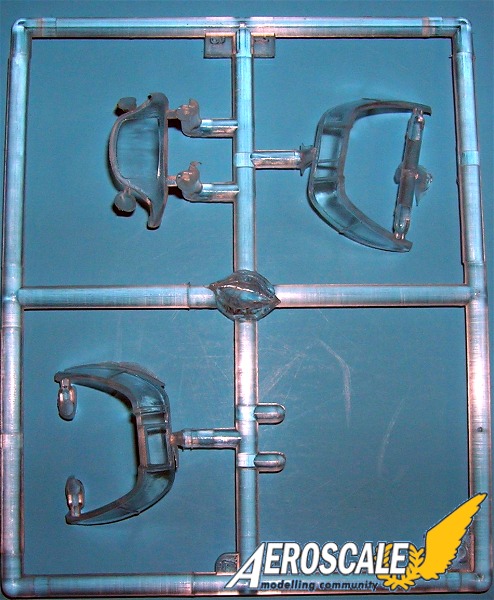
131 parts in the box.
Complete cockpit.
Good details
all plastic.
22 step instructions.
Finish and Camouflage,
All of "these" early production Spad VII types were painted either CDL (clear doped linen) or the basic colour was "Ecru" The fabric paint was several tones lighter than the paint used for the metal cowling ares. The cabane struts and landing ger struts were "marouflage" or wrapped in glue soaked fabric. later examples were painted in the French 5 colour camouflage. One of the profiles here employs this.
Decal Profiles,
SPAD VII C.1 S 2124 of Escadrille N.80 flown by Paul Frank Baer, France, Winter 1917-1918.
SPAD VII C.1 S 1777 of Escadrille N.124 flown by Raoul Lufbery, France, Late 1917.
SPAD VII C.1 S 3301 of the 103 rd Aero Squadron American Expedition Force flown by George Turnure. France, Spring 1918.
References,
‘A Man for Sonderfilme, Rudolf Windisch’ by H Täger, Over the Front 17 #3, Pp.196-232.
‘French Aircraft of the First World War’ by J. Davila & A.M. Soltan, Flying Machines Press, 1997.
‘Hispano-Suiza (Birkigt Patents), Cross & Cockade USA Vol. 10 #3, 1969.
‘Mann Edgerton Spad 7.C1 B9916' by H.G. Fisher, Over the Front Vol. 8 #2 Pp.100-113.
‘Markings of the Lafayette Escadrille’ by B. Alexander, W. Michigan IPMS News 1976.
‘Project Butterfly’ by Hardesty, Hastings, and Toelle, Cross & Cockade USA Vol. 9, 1968 and 13, 1972.- (Most excellent articles on the French 5 colour camouflage patterns.)
‘Spad Scouts S.VII - XIII’ by J.M. Bruce, 1969. Reprint Osprey pub. for Glencoe Models, 1993.
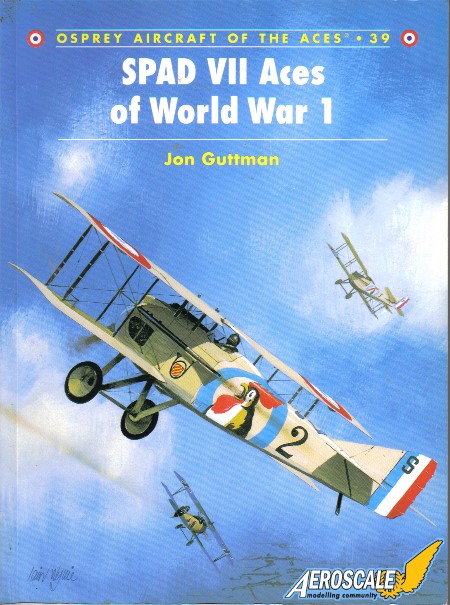
‘Spad VII Aces of World War One ’ by J.Guttman, Osprey Pub.#39. 2001.
‘Spad VII - Original Bleriot Aeronautique general arrangement drawings’ Cross & Cockade USA Vol.15 #4, 1974.
‘Spad 7: 3 View Drawings’, Cross & Cockade USA Vol.2 #1 , 1961.
‘The Real Spad’ by B.S. Kelsey, Over the Front Vol. 8 #2, Pp.114 -122.
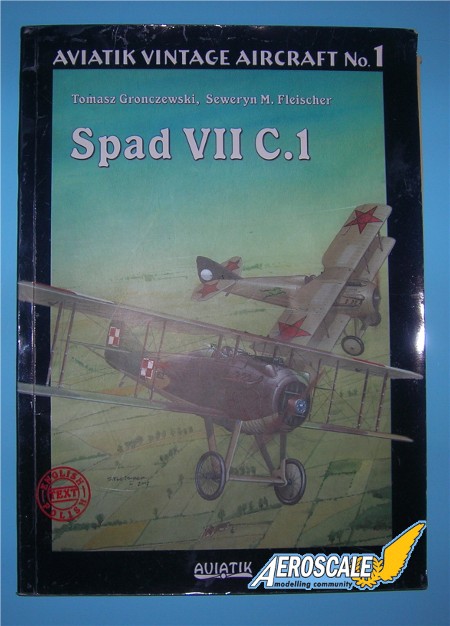
'Spad VII C.1' by Gronczewski & Fleischer , Aviatik Vintage Aircraft #1. See the additional images URL for the errata and addenda to this book.
Comments,
Very Good kit and overall appeal. It fills a gap where there has long been a serious empty space. Another fine example of a smaller company beating the big boys to the punch. The parts that have been gated out foreshadow the future. And it is a fine looking future. Of Special note Roden sent us the first kit and we are doing the first review.
Please remember, when contacting retailers or manufacturers, to mention that you saw their products highlighted here - on AEROSCALE
SUMMARY
Highs: Excellent details. More than enough parts and pieces to do a great build. Very detailed instructions. Rigging instructions are reasonably clear.Lows: Small bit of flash, Vickers is a bit under nourished. Strut bindings a bit too thick.Verdict: Very Good Kit and overall appeal. It fills a gap where there has long been a serious gap. Another fine example of a smaller company beating the big boys to the punch.
Our Thanks to Roden! This item was provided by them for the purpose of having it reviewed on this KitMaker Network site. If you would like your kit, book, or product reviewed, please contact us.
About Stephen T. Lawson (JackFlash) FROM: COLORADO, UNITED STATES
I was building Off topic jet age kits at the age of 7. I remember building my first WWI kit way back in 1964-5 at the age of 8-9. Hundreds of 1/72 scale Revell and Airfix kits later my eyes started to change and I wanted to do more detail. With the advent of DML / Dragon and Eduard I sold off my ...
Stephen,
Looking forward to your build! Why is it that no one seems to do the access panel for the fuselage side that is open wire mesh? All that is missing for some of the more colorful/ interesting schemes!
RAGIII
Looks good on first impression. I too look forwards to your build on this Stephen.
An interesting colourful subject for sure. I don't know the SPAD all that well but the detail looks good and I can see real potential here for sure.
Keith
As with the other 1/32 scale sets the Eduard PE comes in one of two sets.
The coloured self adhesive (3 frets ) Click here.
Or the Zoom set (1 fret) Click here.
Looking at the instructions for the full set I do see one thing worthwhile. All of those turnbuckles and rigging attachments. I was planning to use steel wire but if I get this PE and the courage to use those buckles I could use my usual fishing line rigging. Hmmmmm.....
RAGIII
You should scope out Terri Werner's site, she makes the turnbuckles out of fine brass wire. I have used that method on two models now, and am finally getting it down to a science. Works real well and really simplifies the rigging process.
I have been checking my reference for the SPAD VII, which is limited to several Osprey
titles and there does not seem to be set patterns
by the various manufacturers for the fuselage camouflage. Are there specific patterns
like there were for the SPAD XIII and what would be a good reference source for them?
Also, the Roden kit I picked up with Guynemer on the cover had decals that are badly
out of register. Has anyone had success with getting replacements from Roden and if
so, how did you go about doing it?
Thanks in advance, regards and happy holidays to all.
Dwayne


















Comments